

The Mental Health Benefits of Quilting
Quilting has been touted as a “hobby,” a pleasant pastime, but a lot more than that. Increasing peer-reviewed research demonstrates the correlation between quilting and other crafts and decreased stress, better mood, better concentration, and…
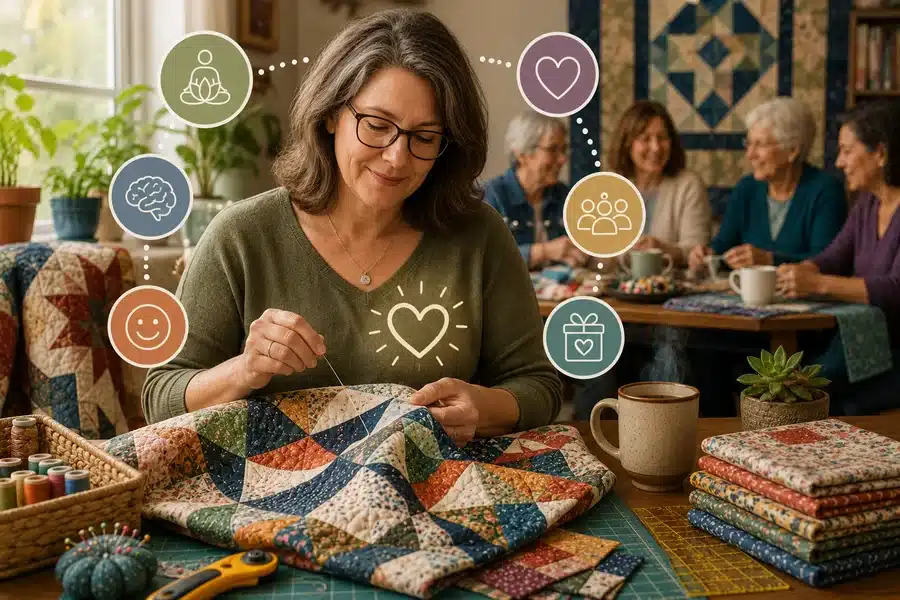
Quilting has been touted as a “hobby,” a pleasant pastime, but a lot more than that. Increasing peer-reviewed research demonstrates the correlation between quilting and other crafts and decreased stress, better mood, better concentration, and better socialization. Here is a pretty straight-forward and evidence-based perspective on quilting and the brain, and each statement backed by a published study.
Key takeaways at a glance
- Studies show that quilting has a significant effect on lowering stress, improving mood and enhancing social connections.
- A study at the University of Glasgow revealed that quilters say they have “flow” while knitting, feel good from the colours and enjoy self-esteem from community.
- The Mayo Clinic Study of Aging found a 28% reduction in the risk of mild cognitive impairment with craft activities.
- Good social relationships, such as those in quilting groups, are as good as not smoking in predicting longevity.
- Quilting is a complement not a substitute for mental health-care services.
What the research says about quilting and mental health
The most directly relevant study comes from the University of Glasgow. Published in the Journal of Public Health in 2012, researchers Emily Burt and Jacqueline Atkinson interviewed 29 members of a quilting group to understand how the craft affected their wellbeing. They identified three intertwined processes (cognitive, emotional, and social) that quilters consistently linked to feeling better.
The participants described feeling “flow” when working with color, uplifted psychologically by working with color, and feeling more worth because of the friendships that were formed through quilting (Burt & Atkinson, 2012). In conclusion: Quilting was a systematic, repeatable process, that could engage the mind, calm the emotions and keep people connected.
The results form part of an expanding evidence base of creative craft and wellbeing. Each benefit is described below along with the research supporting that benefit
1. Quilting reduces stress and anxiety
Measuring, cutting, piecing and stitching is a rhythmic activity which has a calming effect on the nervous system, which is a calming effect of quilting. The mind finds solace in repetition, and it calms the racing mind.
This is backed up by the largest ever study of a similar craft. Riley, Corkhill and Morris (2013) polled 3,545 knitters worldwide to find that the top three reasons for knitting were relaxation, stress reduction and creativity, with an increase in knitting frequency being significantly associated with feeling calmer and happier.
2. Quilting creates “flow” and mindfulness
The psychological state of being totally absorbed in a task so that it appears to have no passage of time has been described by psychologist Mihaly Csikszentmihalyi in his 1990 book “Flow.” It’s a challenge to push to the limit without becoming intimidating, and quilting seems to be ideal for that—challenging enough to require full attention, but not so hard that it can’t be done.
And this isn’t only theory. The Glasgow study (Burt & Atkinson, 2012) was one of the few studies that included flow as a core experience quilters reported. There’s barely a place in the mind to spare for concerns when matching seams or laying out a color scheme. This present-focused state is very similar to mindfulness, which is widely practiced today in modern psychiatric care to help with anxiety levels and low mood.
3. Quilting boosts mood and self-esteem
When you complete a quilt, or even just a single block, you feel a sense of achievement. You can see, touch and use the fruits of your labours and that very visual and tangible evidence of your progress gives you a sense of competence and pride.
The Glasgow researchers discovered that affirmation by other quilters raised the self-esteem and motivation of the participants to learn new skills (Burt & Atkinson, 2012). This gives a sense of self-worth and purpose that acts as a buffer against low moods and can be achieved through completing meaningful projects.
4. Quilting is a brain healthy, attention gaining activity.
Quilting is a more complicated process than it appears. The ability to recognize patterns, work out measurements, solve fit issues, and mix colors all involve thinking and problem solving – a real brain workout!
The battle could have long-term benefits. The Mayo Clinic Study of Aging tracked 1,929 cognitively normal older people, finding that those who engaged in craft activities had a 28% reduced risk of developing mild cognitive impairment, a condition between normal aging and dementia (Krell-Roesch, Geda et al., published in JAMA Neurology, 2017). This benefit was most pronounced for those who created at least weekly.
5. Quilting fosters social connectedness
Quilting is not an individual sport, it is a social sport. Quilters gather in groups: quilting circles, quilting guilds, quilting classes, quilting retreats and on-line quilting groups. The Glasgow study particularly focused on the facilitation of these networks, and the increase in confidence and strong friendships that were reported by those participating (Burt & Atkinson, 2012).
How is it that it is such an important question? In a groundbreaking meta-analysis of 148 studies and over 300,000 individuals published in the journal PLoS Medicine, strong social ties were linked to a 50% increased risk for mortality compared to having weak, absent or negative relationships, similar to the effects of other well-established risk factors such as smoking (Holt-Lunstad, Smith & Layton, 2010). A quilting community is a tangible form of support, protection and connection for anyone who is feeling lonely, retired or is experiencing a major life change.
6. Quilting creates a sense of purpose through giving
Quilts are frequently designed to be given away, such as to the new baby, the sick person, charity, or even to people who have lost their homes during a disaster.
This selfless giving was seen to bring an extra dimension of purposefulness to the craft by the Glasgow researchers (Burt & Atkinson, 2012). The emotional payback from a hobby is two-fold when you can make someone else feel comfortable.
Who benefits most from quilting
While anyone can enjoy these effects, quilting is especially valuable for:
- Elderly people (cognitive stimulation, routine and social interaction benefits).
- Those with stress, anxiety and low moods who find its mindful, calming beat helps them.
- Individuals who feel isolated and/or are facing significant life changes, who benefit from having a place to belong in a quilting group.
- Anyone who wants a creative outlet without the screen in an over stimulated, always on world.
How to start quilting for your wellbeing
You don’t need talent or experience to begin, just a willingness to make something one stitch at a time. A few gentle starting points:
- Begin small. A simple table runner, pillow, or baby quilt is far less intimidating than a full-size project and delivers that rewarding sense of completion sooner.
- Use a beginner kit. All-in-one starter kits and Block of the Month programs, like the beginner quilt kits from Stitchin’ Heaven, take the guesswork out of fabric and pattern selection, so you can focus on the relaxing part rather than the logistics.
- Make it a ritual. Set aside regular, protected time for quilting and treat it as genuine self-care, not a chore to finish.
- Find your people. Join a local guild, take a class, sign up for a quilting retreat, or connect with an online community to layer in the social benefits.
A balanced note
Quilting is great for promoting a healthy lifestyle, but it is not a substitute for health care. However, if you are feeling anxious, depressed or have other mental-health issues that are not going away, a craft can help with your wellbeing – not instead of professional help. Consider quilting as one tool in the tool box for a sense of wellbeing.
Frequently asked questions
Is quilting good for anxiety?
Yes. Its repetitive, rhythmic motions and the deep focus it requires can calm the nervous system and interrupt anxious thought patterns, producing a meditative, present-focused state. Survey research on knitting, a closely related craft, links frequent crafting with feeling calmer (Riley et al., 2013).
Can quilting help with depression?
Quilting can support mood through accomplishment, creative expression, and social connection, all of which buffer against low mood. It works best as a complement to professional treatment rather than a substitute.
Is there real scientific research on quilting and mental health?
Yes. A 2012 University of Glasgow study in the Journal of Public Health (Burt & Atkinson) documented quilting’s cognitive, emotional, and social benefits, and broader research on crafting links it to reduced stress and better cognitive aging.
Do I need to be artistic to quilt?
Not at all. Beginner-friendly patterns and kits make quilting accessible to anyone, and the mental-health benefits come from the process, not from producing a masterpiece.
How often should I quilt to feel the benefits?
Even short, regular sessions help. In cognitive-aging research, crafting one to two times per week was the threshold associated with the clearest benefit (Mayo Clinic Study of Aging).
The bottom line
Quilting has real mental health benefits and they are now more and more being documented. They are stress-reduction, mindfulness, mood enhancement, thinking, and connecting with others, and few hobbies can deliver all of those. From the peaceful beat of the beat to the satisfaction of a completed creation to the sense of community among quilters, there are so many positive aspects to learning how to pick up a needle and thread.