

AFRINIC and APNIC: How Regional Internet Registries Support Global Connectivity
The internet can be a single global network but its facilities are handled about by well coordinated regional system. All websites, clouds, data centers, internet service providers, and connected devices rely on numerical resources enabling…
The internet can be a single global network but its facilities are handled about by well coordinated regional system. All websites, clouds, data centers, internet service providers, and connected devices rely on numerical resources enabling networks to designate and communicate with each other.
Some of the organizations that will manage these resources are AFRINIC and APNIC. Both are Regional Internet Registries, or RIRs, but one serves another part of the globe and addresses the unique requirements of the regional internet communities.
This is because understanding the way these organizations operate can help internet service providers, hosting businesses, telecommunications companies, enterprises, and network professionals operating with IP addresses or Autonomous System Numbers.
What Is a Regional Internet Registry?
An organization that allocates and assigns internet number resources in a specific geographical region is called a Regional Internet Registry.
The principal resources managed by RIRs include:
- IPv4 addresses
- IPv6 addresses
- Autonomous System Numbers, or ASNs
IP addresses recognize the devices and network infrastructure that is part of the internet. ASNs determine autonomously controlled networks, which share routing information with other networks.
The internet is hierarchical, instead of issuing all IP addresses directly by one single global organization. Blocks of resources are directed worldwide and then availed to RIRs, which have a break in their different regions based on community-formulated policies.
This is a strategy of worldwide coordination and local expertise.
The Five Regional Internet Registries
There are five RIRs serving different parts of the world:
- AFRINIC serves Africa.
- APNIC serves the Asia-Pacific region.
- ARIN serves the United States, Canada, and several Caribbean territories.
- LACNIC serves Latin America and parts of the Caribbean.
- RIPE NCC serves Europe, the Middle East, and parts of Central Asia.
Despite the fact that these bodies have similar core functions, the policies, membership mode, procedures and regional priorities of these organizations may vary.
The two of the most notable ones are AFRINIC and APNIC, which serve those areas where the connectivity, cloud infrastructure, mobile services, and digital commerce are growing rapidly.
What Is AFRINIC?
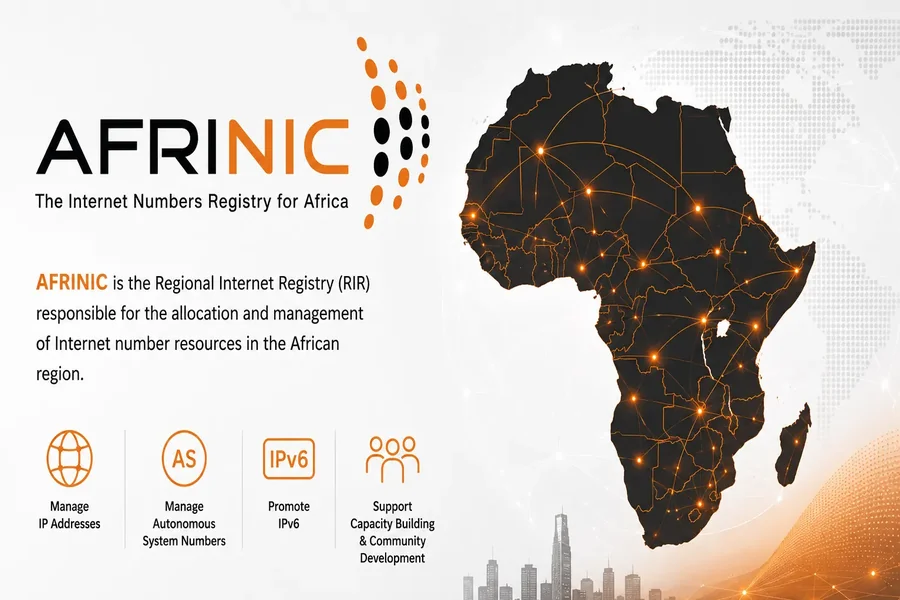
The AFRINIC is the Regional Internet Registry which serves Africa.
The organizations that are within the region can relate to AFRINIC when they require internet number resources, desire to update their registration information or when they desire to contribute in the regional policy discourse.
A closer description of what AFRINIC is and how it benefits the African internet community can assist in making network operators realize its place under the umbrella system of the global registeries.
The functions of AFRINIC are to allocate and register addresses in IPv4 and IPv6, assign ASN, maintaining records of resources, policy development, and technical education.
Its community may include:
- Internet service providers
- Telecommunications operators
- Data centers
- Cloud and hosting companies
- Universities and research networks
- Government institutions
- Financial organizations
- Large enterprises
- Internet exchange points
Through these activities, AFRINIC contributes to the development of internet infrastructure across the continent.
Why AFRINIC Matters to Africa’s Digital Growth
The digital economy in Africa is growing with increasing numbers of individuals and companies becoming mobile-connected, accessing online banking, cloud computing, e-commerce, and digital government services.
This expansion needs effective internet infrastructure.
Network operators require space on the address space in order to connect customers and provide new services. Applications require a scaled IP in data centers. Businesses might need their own provider-independent address and ASNs to enhance resilience, as well as to decrease their reliance on a single network carrier.
The AFRINIC is able to facilitate this ecosystem by sustaining the regional structure where these resources are registered and managed.
The organization also provides opportunities for the regional technical community to discuss issues such as:
- IPv6 deployment
- Internet routing security
- Resource transfers
- Registration accuracy
- Network resilience
- Internet governance
- Technical skills development
Because internet conditions differ across countries and regions, local participation is essential. Policies that work well in one market may not fully address the operational realities of another.
What Is APNIC?
APNIC is the Regional Internet Registry for the Asia-Pacific region.
Its network has a vast and diverse range of economies, comprising of highly developed digital markets, fast-growing internet connections, remote island nations, and nations with large telecommunications and cloud sectors.
Businesses and network operators can learn more about what APNIC is and how it manages internet number resources before applying for resources or expanding their operations within the region.
Like other RIRs, APNIC is responsible for allocating and registering IPv4 addresses, IPv6 addresses, and ASNs. It also supports policy development, technical training, research, network measurement, and regional cooperation.
Its community includes organizations ranging from small internet providers to some of the world’s largest network operators.
Why APNIC Matters to the Asia-Pacific Region
The Asia-Pacific region contains a substantial share of the world’s internet users and some of its fastest-growing digital economies.
Demand for internet infrastructure is driven by:
- Cloud computing
- Mobile connectivity
- Streaming platforms
- Artificial intelligence services
- E-commerce
- Online gaming
- Financial technology
- Internet of Things deployments
- International data centers
Managing growth at this scale requires accurate registration records, effective resource policies, and strong technical coordination.
APNIC helps organizations obtain and manage the resources needed to operate independent networks. It also supports knowledge sharing through conferences, training programs, technical publications, and community initiatives.
These activities are especially important in a region where network maturity and technical capacity vary widely between markets.
AFRINIC and APNIC: What Do They Have in Common?
AFRINIC and APNIC serve different geographic regions, but their fundamental roles are similar.
Both organizations:
- Allocate and register internet number resources
- Maintain information about resource holders
- Support community-led policy development
- Promote IPv6 adoption
- Provide technical training and educational materials
- Encourage secure and stable internet routing
- Facilitate cooperation between network operators
Neither organization controls the content transmitted over the internet. Their role is focused on the numerical resources and technical coordination that allow networks to connect.
They also do not function simply as commercial IP address vendors. Their allocation and registration activities are governed by policies developed through their respective communities.
Key Differences Between AFRINIC and APNIC
The main difference is geographic responsibility.
AFRINIC serves organizations operating in Africa, while APNIC serves the Asia-Pacific region.
Because their service areas have different economic conditions, infrastructure challenges, and market dynamics, each registry develops policies and services suited to its community.
Differences may arise in areas such as:
- Membership procedures
- Resource eligibility
- Documentation requirements
- IPv4 transfer rules
- Fees
- Database management
- Policy timelines
- Regional training priorities
An organization should therefore consult the rules of the registry responsible for the region in which it operates. Experience with one RIR does not automatically mean that every process will be identical in another.
The Importance of Accurate Registry Information
RIR databases associate IP address ranges and ASNs with the organizations responsible for them.
Keeping this information accurate supports:
- Network troubleshooting
- Abuse reporting
- Security investigations
- Routing coordination
- Resource transfer verification
- Operational communication
- Regulatory and commercial due diligence
Outdated or incorrect records can make it more difficult to identify the party responsible for a network resource.
Organizations should update their registry information when contact details, corporate ownership, resource usage, or network operations change. This is particularly important following mergers, acquisitions, restructuring, or asset transfers.
AFRINIC, APNIC, and IPv4 Scarcity
IPv4 has a limited address space, and the supply of unused addresses available through traditional allocation has become constrained.
As a result, businesses may obtain IPv4 resources through transfers, leasing arrangements, acquisitions, or partnerships with service providers.
RIR records and policies remain important in these transactions. Before using or acquiring an IPv4 range, an organization should confirm:
- Which RIR maintains the registration
- Whether the party offering the resource has the authority to do so
- Whether the proposed transfer is permitted
- Which documents are required
- How the registry information will be updated
- Whether the address range has routing or reputation issues
A technically routable address range is not necessarily a risk-free asset. Proper legal, operational, registry, and reputation checks should all form part of the due-diligence process.
Supporting the Transition to IPv6
IPv6 offers a dramatically larger address space and is intended to support the internet’s long-term expansion.
Both AFRINIC and APNIC encourage IPv6 adoption by allocating resources, publishing guidance, training network professionals, and supporting regional deployment initiatives.
However, obtaining IPv6 addresses is only the beginning. Organizations also need to prepare their:
- Routers and firewalls
- Operating systems
- Applications
- Monitoring platforms
- Security policies
- Domain Name System configurations
- Staff and operational procedures
For many businesses, dual-stack operation—supporting IPv4 and IPv6 simultaneously—will remain necessary during the transition.
Read More: What Is a Jet Card for Creators Today
Choosing the Correct Registry
Typically, an organization liaises with the RIR that governs the zone in which an organization has its network and business operations anchored.
An organization that is based only in Africa would tend to interact with AFRINIC and an organization based in the Asia-Pacific region would tend to interact with APNIC.
Multinationals can be registered in multiple registries. This may occur when a company is operating network in various regions, purchasing address space that has been registered in other places, or even when there is an inter-regional transfer.
Businesses ought to identify before applying to or obtaining resources:
- Which registry has authority over the relevant region.
- Whether direct membership or a sponsoring organization is required.
- What technical need must be demonstrated.
- Which fees and ongoing obligations apply.
- Whether transfer or leasing activity is permitted.
- How registration records must be maintained.
Professional guidance can be valuable when a transaction involves multiple jurisdictions or registries.
Final Thoughts
AFRINIC and APNIC are the important constituents of the global internet infrastructure system.
The AFRINIC is in favour of network development and coordination efforts in Africa, whereas the APNIC caters to the diversified and swiftly growing internet community in Asia-Pacific. Both organizations aid in the assurance that IP addresses and ASNs are allocated, registered, and administered by obvious regional procedures.
To businesses and network operators, it is not just an administrative issue to know what is the right RIR. Registry policies have the potential to affect the network growth, transactions of IP addresses, routing activities, compliance, and infrastructure planning.
With an increased demand of digital services the efforts of AFRINIC, APNIC and the rest of the Regional Internet Registries will continue to be the primary pillars of a steady, secure and globally connected internet.