

What is an ABIS system and how does it work?
Biometric identity verification is a feature offered by identity management systems, that rely on the Automated Biometric Identification System (ABIS). The ABIS uses a biometric probe to match a live sample against records in a…
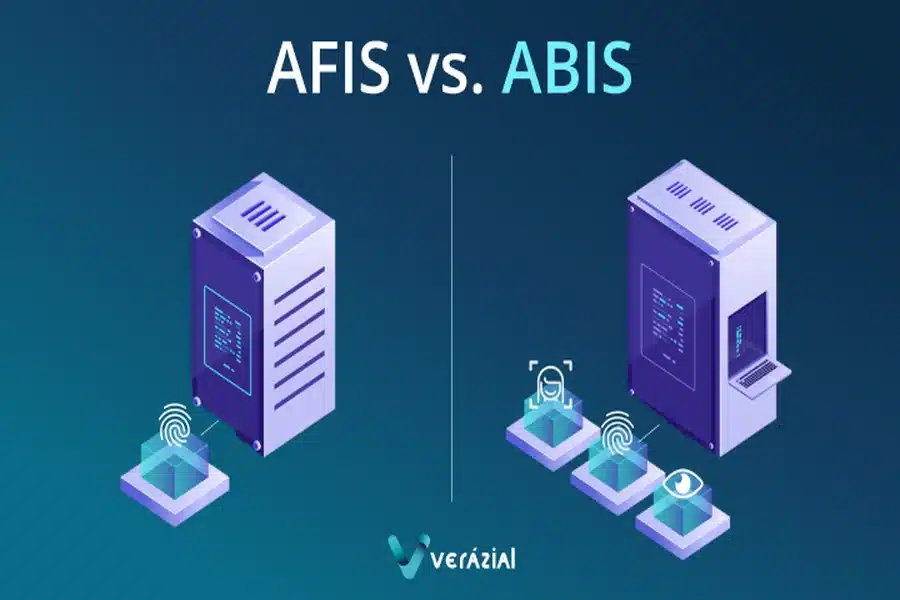
Biometric identity verification is a feature offered by identity management systems, that rely on the Automated Biometric Identification System (ABIS). The ABIS uses a biometric probe to match a live sample against records in a database, which can contain multiple templates for a single identity. In contrast to other single identity verification solutions available as mobile applications, mass market identity verification systems, that rely on an ABIS, verify identities of millions of individuals and store millions of identity records in databases.
How an ABIS works
An ABIS contains three key processes that are ran in sequence to identify or verify a person. The first process of these is enrollment, where a person’s biometric data is collected and then stored within an ABIS database. Examples of biometric data that can be collected during the enrollment process include fingerprinting, iris scanning, facial images and even images of individuals’ Palm Prints.
When a person’s information is added to an ABIS during the enrollment process, the first step that the system does with that person’s information is to extract features from the biometric sample that was collected. This step is called feature extraction. During feature extraction, all of the different aspects of the sample are looked at individually, and the unique aspects are pulled out. These are then put together in a format that can be used for comparison with other samples. For example, during the enrollment process for a fingerprint, each of the different ridge endings and bifurcations on the fingerprint are looked at individually, and the information from each of them is extracted and put together in the sample’s biometric template. This is then stored in the database for later use.
Once an identity has been added to the database and stored in the ABIS, that identity can then be matched against a previously captured live biometric sample. In general, there are two types of matching that can take place, Identification and Verification. Identification matching is also known as 1:N matching. This type of matching is a search against the entire database of stored identities to find the closest match to the probe. Verification or 1:1 matching is a comparison of the live sample against a single stored identity. The goal of verification is to verify that the person presenting the live sample is in fact the claimed identity. MegaMatcher ABIS is designed to handle large volumes of 1:N and 1:1 matching in real time, and can support many different modalities of biometrics.
The system then makes a determination based on the results from the comparison and the threshold score that was pre-set for the match. If the newly captured template and the stored template(s) produce a similarity score greater than the threshold score, then a match has occurred.
Industry Applications
There are many industries that are currently incorporating Biometric solutions in order to protect and manage information within an organization, as well as to process various records and administrative tasks.
National ID and Voter Registration
An ABIS is also used by governments for large-scale citizen enrollment into a National ID program as well as for Voter Registration. By cross-checking newly enrolled identities against those already stored in the database, duplicate identities can be prevented. Individuals will be issued with one ID card only and registered as a voter accurately in order to help prevent voter fraud and ensure that every citizen has equal access to government services.
Law Enforcement
As the technology evolves and law enforcement agencies across the globe come to terms with the vast potential at their fingertips, the role of an ABIS in police investigations becomes increasingly important. In addition to providing investigators with latent print comparisons against the known offenders in databases, such as IAFIS, investigators are now able to upload images of individuals of interest to compare against vast amounts of pictures in databases, to include facial recognition images retrieved from a variety of security cameras throughout a city.
Border Control and Immigration
For Border Control, ABIS can be deployed for the Biometric Screening of persons entering and leaving a country. Facial images or fingerprint images can be captured at airports and border crossing points and then searched against watch lists or against the visa holder database to allow or deny entry into a country.
Financial Services
As more financial services organizations offer a wider portfolio of financial services and products online, to customer’s door or in a branch, there is an increased risk of account compromise by identity theft or by an unauthorized person obtaining access to a customer’s online banking services. To combat this, many financial services organizations are now turning to an enterprise wide biometric solution to protect their online customer base. Using advanced biometric checks on customers during the account opening process, financial services organizations can ensure that all customers are genuine and help ensure that all customers are verified in line with strict identity verification regulations.