

Meet IFANN – The Social Network Built for Fans Who Care a Little Too Much (Interview)
Every now and then a product lands on our radar that simply does not behave like everything else in the feed. For us, lately, that product has been IFANN. We first came across it just…

Every now and then a product lands on our radar that simply does not behave like everything else in the feed. For us, lately, that product has been IFANN.
We first came across it just as you do with most things these days: It kept popping up. The amount of users was steadily increasing, the screenshots were much more polished than the typical social-early-stage app, and the “purpose” was feeling far more specific than it would be at this early stage of a social app. It was not the “Twitter, but just a little different. It was something meant expressly for fans—the people who care a whole lot more about their favourite characters, shows, artists and teams than the average scroller.
So we reached out. We sought to know what IFANN actually is, why it has come into being and where it is going. So we sat down with Evan Atkinson, their Chief Technology Officer to find out. The discussion has been edited slightly for length and clarity.
Let’s start simple. In one breath, what is IFANN?
Evan Atkinson: IFANN is a social platform built around the things you are a fan of. Most networks are built around people you know or accounts you follow. We flipped that. On IFANN, the center of gravity is the fandom itself: the anime you cannot stop thinking about, the drama you binged in a weekend, the artist, the game, the character. You come to IFANN to be around other people who care about that thing as much as you do. That is the whole idea in one line.
And where can people actually find it right now?
Evan Atkinson: Today we live at ifann.pages.dev It is a web app, fully usable in your browser on desktop or mobile. We are still early, so think of this as the version where the foundations are in place and we are building outward quickly.
You said you “flipped” the model. Where did that instinct come from?
Evan Atkinson: Honestly, it came from watching how fandoms already behave, and how badly the big platforms serve them. There is a particular kind of person who does not just watch a show, they live inside it. They learn the characters, the lore, the behind-the-scenes details. They want to talk about it constantly, and they want to talk to people who get it, not people who will roll their eyes.
For a lot of us on the team, the spark was anime fandoms and foreign drama fandoms specifically. Those communities are enormous, deeply passionate, and spread all over the world, but their conversations are scattered across a dozen apps that were never designed for them. We thought: what if there were one home for that emotional kind of fandom? A place where people who share those intense interests could find each other and bond easily, without fighting an algorithm that does not understand why they care. That was the original mission. Help people who feel strongly about the same things relate and connect.
That is a clear emotional core. Has the vision stayed that narrow, or is it widening?
Evan Atkinson: It is widening, naturally. We started with “a home for fandoms,” but the more we built, the more we realized the same foundation can support a lot more. We are now looking seriously at a creator and user rewards programme that would let people share content, anything that is DMCA-compliant and non-infringing, with real audiences on the platform and actually be recognized for it. So the ambition is growing from “a place to talk about what you love” toward “a place to create and be rewarded for it too.” But the fandom heart stays the same.
Read more: Chace Crawford Height and His Journey in Hollywood
Let’s get into the product itself.
Evan Atkinson: This is the part I am most proud of, so forgive me if I go long.
Every meaningful thing on IFANN is what we call an entity. A person, a show, a movie, a character, a game, a musician, a team, even a topic. Each entity is a first-class citizen with its own dedicated space. So instead of only following your friends, you follow the entities you care about, and your feed becomes a living stream of everything happening around them: posts from other fans, news, discussion, art, clips, polls, the lot.
The reason that matters is discovery. On a normal network, if you love a particular character, you have to go hunting for the right hashtags and hope. On IFANN, that character has a page, a feed, and a community already gathered around it. You show up and you are instantly among your people. The entity feed is the engine that makes the whole “find your fandom” promise real instead of just a slogan.
You also have wiki pages. How do those fit in? Is it like Wikipedia?
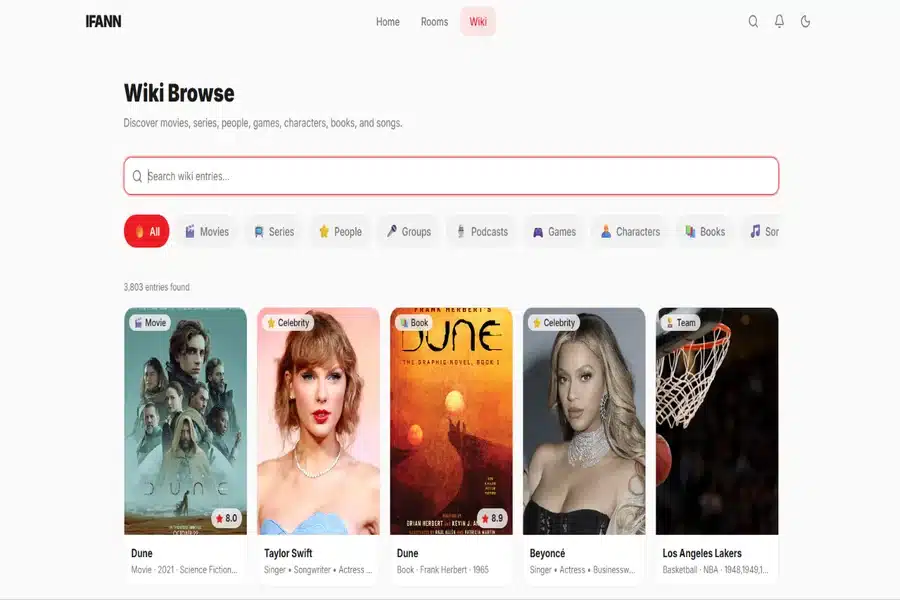
Evan Atkinson: It is related but it serves a different job. Every entity can have a wiki, a clean, structured page that holds the things fans actually want to know. For a person that might be their background, their career, their relationships, key facts. For a show it might be the premise, the cast, where to watch, the standout moments.
The difference from a traditional encyclopedia is that our wikis sit right next to the conversation. You can read the facts about a character and then immediately drop into the live feed of people discussing that character. Knowledge and community in the same place. And because it is fandom-driven, the wikis cover the long tail that mainstream encyclopedias often ignore or treat as too niche. That long tail is exactly where superfans live.
From a technology standpoint, that sounds hard.
Evan Atkinson: The entity graph, mostly. Connecting content to the correct entities reliably, at scale, is a genuinely hard problem, and getting it wrong is very visible to users. We put a lot of engineering into understanding what a piece of content is actually about and routing it to the right places automatically, so a fan does not have to do manual tagging gymnastics. Keeping the wikis fresh and trustworthy as the catalog grows is the other big one. It is the kind of work that is invisible when it goes well and extremely obvious when it does not.
What about formats? Is IFANN mostly text, or more than that?
Evan Atkinson: More than that. We support the full range fans expect: text posts and threads, images, polls, community spaces for longer discussion, and video, both short clips and longer pieces. Fandom culture is incredibly visual and incredibly video-driven, so video is not an afterthought for us. The goal is that whatever way you like to express your fandom, whether you write essays or cut clips, IFANN has a native home for it.
Let’s talk growth. You are clearly still early. How are you bringing people in right now?
Evan Atkinson: We are in a very hands-on, experimental phase, running real-world trials rather than guessing. Two things in particular. First, we are actively recruiting content creators, people who can bring quality and energy to specific fandoms and give those communities something to gather around. Second, we are running targeted ad campaigns across very different interest groups, testing how various fandoms respond and learning what actually resonates with each one. It is deliberately scrappy and data-driven. We would rather learn fast from real users than polish in a vacuum.
A lot of your inspiration is international, anime and foreign dramas.
Evan Atkinson: Absolutely. Those fandoms are global by nature. An anime can have just as many passionate fans in New York, São Paulo or Manila as it does in Tokyo. So we are building with that in mind, and multi-language support is on the near-term roadmap. The whole point is to let fandoms across the world relate and connect in one place, and you cannot do that if everyone is forced into a single language. Making IFANN feel native in more languages is one of the next big unlocks for us.
Quick one. Where does the name come from?
Evan Atkinson: It is right there in the word. “I fan.” It is about the fan, you, putting the fan at the center of the experience. Everything we just talked about flows from that.
Last question. Picture this conversation a couple of years from now. What does success look like?
Evan Atkinson: Success is when someone discovers a new obsession, a show, an artist, a game, and their first instinct is not to open a generic timeline and shout into the void. It is to open IFANN, because they know that is where the people who love it already are, where the knowledge lives, and where their own contributions actually count. If we become the default home for fandom, the place you go to feel less alone about the things you care about most, then we have done our job. We are a long way from there, but everything we are building points in that direction.