

Common Beginner Gaming Mistakes That Omaha Makes Obvious in Seconds
Beginner poker mistakes rarely announce themselves. They usually feel reasonable in the moment: one extra call, one attractive starting hand, one quick assumption about the board. Omaha makes those habits easier to see because the…
Beginner poker mistakes rarely announce themselves. They usually feel reasonable in the moment: one extra call, one attractive starting hand, one quick assumption about the board. Omaha makes those habits easier to see because the format gives players more cards while asking for stricter hand reading. More options do not mean more clarity.
A useful way to think about poker learning is pattern recognition. Research on flexible decisions and chess expertise shows how skilled players evaluate changing positions by comparing lines, not staring at one tempting move. Omaha rewards similarly flexible thinking. A beginner who only sees “four cards” may feel invited into too many hands. A careful player sees how those cards connect, how position matters, and how the board can change the meaning.
Why Omaha Shows Habits So Clearly
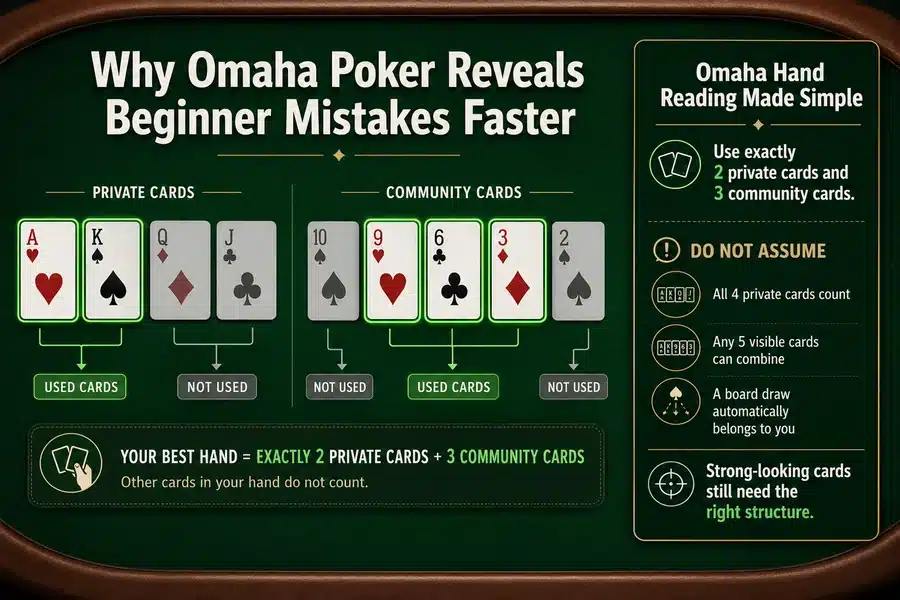
Image source: Custom visual created by the author for this article
Omaha is a strong teaching lens because it looks familiar before it feels different. Texas Hold’em players will recognize blinds, community cards, betting rounds, and the race to make a 5-card hand. The twist is that Omaha gives each player 4 private cards and asks them to build a hand in a much more specific way. Ignition’s guide to the rules of Omaha Poker explains the key point: players must use exactly 2 cards from their hand and exactly 3 from the board.
That rule is what exposes beginner poker mistakes so quickly. A player may see 4 coordinated cards and treat the whole group as equally usable. They may see the same suit coming up repeatedly on the board and not check whether they have the right cards in their hand to make a flush with it. They may overvalue a pair because the extra hole cards make the hand look more flexible than it really is. Once the rules of Omaha Poker are understood, the format becomes a clear way to study hand selection, position, board texture, and emotional patience in one place.
The idea becomes easier with a visual example. Ignition’s short video, From Fish To Shark: Avoid These 10 Poker Mistakes, works well here because it covers practical errors across formats: entering too many hands, calling without a plan, ignoring position, misreading board texture, and letting emotion shape decisions. After the Omaha rule explanation, it works as a map of habits that Omaha reveals faster.
The Hands That Look Better Than They Are
The first beginner trap in Omaha is visual abundance. Four hole cards create more possible connections, which makes weak structure harder to notice. A hand can contain a pair, a suited card, and a few connected ranks while still lacking a clean plan. That is why Omaha beginners often struggle less with memorizing rules and more with resisting hands that look tempting but lack actual utility.
Here is a simple way to see the difference:
| Beginner Read | What Omaha Asks You To Notice |
| “I have 4 cards, so I have many ways to connect.” | The hand must work through exactly 2 private cards, not any loose mix. |
| “The board has lots of cards of one suit.” | A flush still needs 2 matching suited cards in hand. |
| “Top pair looks strong.” | Board texture may point toward straights, flushes, sets, or stronger two-card combinations. |
| “Late position feels like a bonus.” | Acting later gives more information, which matters more when boards change quickly. |
Hold’em teaches beginners to think about hand strength, position, betting rhythm, and opponent behavior. Omaha keeps those ideas, then makes the card-selection filter more exact.
Position Changes The Meaning Of The Same Cards
Position is not just a seat marker. It changes how much information a player has before acting. In early position, a decent-looking Omaha hand can create difficult choices because several players still have time to raise, call, or fold behind. In later position, the same hand can be read with more context.
This is why poker position mistakes often feel subtle. A beginner may think the cards are the main story, while the order of action is only a background detail. Omaha challenges that view. When more card combinations are possible, the value of acting with extra information rises. A cautious fold in early position may be the better choice.
Board Texture Is The Real Conversation
Board texture is also something that many beginners underread. The flop, turn, and river do not just add cards. They change which stories are believable. A connected board invites straight possibilities. A paired board changes full-house and trips considerations. A suited board asks whether the right private cards are actually present.
This does not mean every hand needs a long analysis. It means the first read should be disciplined. What 2 hole cards are being used? Which 3 board cards matter? What hands could another player reasonably have? Omaha becomes less overwhelming when the question shifts from “What do I hope I have?” to “What can this hand actually be?”
The best beginners are not those who have robotically memorized hand rankings. They are observant. They learn to pause before calling, treat position as information, and see board texture as part of the hand, rather than just decoration. That is what turns repetition into understanding, not simple familiarity alone. That steadier mindset is why attention matters as much as memory.