

Warehouses Getting Smarter: How It Shows Up in Your Everyday Life
Warehouses aren’t just big rooms with shelves anymore. They’re becoming highly organized systems where the main goal is to get the right item…

Warehouses aren’t just big rooms with shelves anymore. They’re becoming highly organized systems where the main goal is to get the right item to the right person with as little wasted time and space as possible.
Modula US is one of the companies building warehouse technology that makes it faster to find and pick products. The trick is making it all work in real life, without turning the place into a confusing sci-fi movie.
The Part of Shopping We Don’t See
There’s a lot that goes on between the moment you click “Buy” on that online order and the moment you open the box. And most of it happens in the warehouse. The problem is that if this part of the process is low or messy, the customer doesn’t think “Wow, that facility’s processes need work.” They think “This store is unreliable,” and they don’t order again.
Any given warehouse has a lot going on, but most of the daily pain boils down to two questions:
- Where is the thing?
- How quickly can we bring it to the right place?
Say you order a phone case. That case might currently be sitting in a bin, on a shelf, inside a tote, in an aisle that looks identical to ten other aisles. Someone has to locate it, grab it, and bring it to packing.
Problem #1: Walking
That act of grabbing items for orders is called “picking,” but you don’t need the term. Just imagine a person with a cart walking through a huge building doing “phone case… phone case… phone case…” all day long. If the building is laid out poorly, that person spends more time walking than picking.
Too much walking sounds harmless enough until you add it all up.
Picture a worker who has to walk 30 seconds to reach a shelf, grab one item, then walk another 30 seconds to the next location. If that happens hundreds of times, you end up paying for a lot of footsteps.
If you’ve ever cooked in a kitchen where the spice shelf is across the room from the burners, you’ve felt the same issue. You can still cook, but you waste motion constantly.
Problem #2: Inventory errors
Inventory errors are particularly brutal because they create hidden work.
Example: a screen says you have 12 units of something. A picker goes to the location and finds 0. Now they have to double-check nearby shelves, ask a supervisor, or mark the order as short. Meanwhile, everything else backs up.
This is why warehouses obsess over accuracy. Not because accuracy is a moral virtue, but because inaccuracy creates surprise detours, and surprise detours destroy speed.
What Successful Automation Looks Like
When people hear “warehouse automation,” or automation of any kind, really, they often default to Jetsons-style humanoid robots. In reality, a lot of automation is much less dramatic and much more practical.
One common idea is “goods-to-person.” Instead of a person walking to shelves all day, the storage system brings the right tray/bin to the person at a workstation.
So, the old way was a worker going to find that elusive phone case somewhere in Aisle 12. The new way is for the worker to stand near a picking station and have the phone case delivered straight to them.
You can think of it as the difference between browsing a massive library to find one book, versus requesting the book and having it delivered to the front desk.
This is where solutions like vertical storage, automated retrieval, and better software coordination come in. The point isn’t to replace every human task, but to remove the slowest, most repetitive parts.
The Freight Angle
Warehouses are also under pressure to store more products closer to where people live. That’s partly because customers expect quicker delivery, and partly because inventories have gotten more complex.
One way to visualize the pressure is to look at freight movement and logistics activity over time. The Bureau of Transportation Statistics publishes Freight Facts and Figures with charts and interactive visuals that show how much stuff moves around the US, by mode and trend.
What All This Means for Jobs
A lot of warehouse tech is less about getting rid of workers and more about changing what workers spend time on.
You’ve seen this shift if you’ve ever been in a store with self-checkout. The store didn’t eliminate all cashiers. It simply changed the flow, with fewer people doing scanning and more people helping customers, watching exceptions, and managing the system.
Warehouses are similar. As more tasks become system-guided, the job often moves toward operating workstations, handling exceptions, and doing quality checks. Someone still needs to solve problems when a bin is damaged, an item is mislabeled, or an order is unusual.
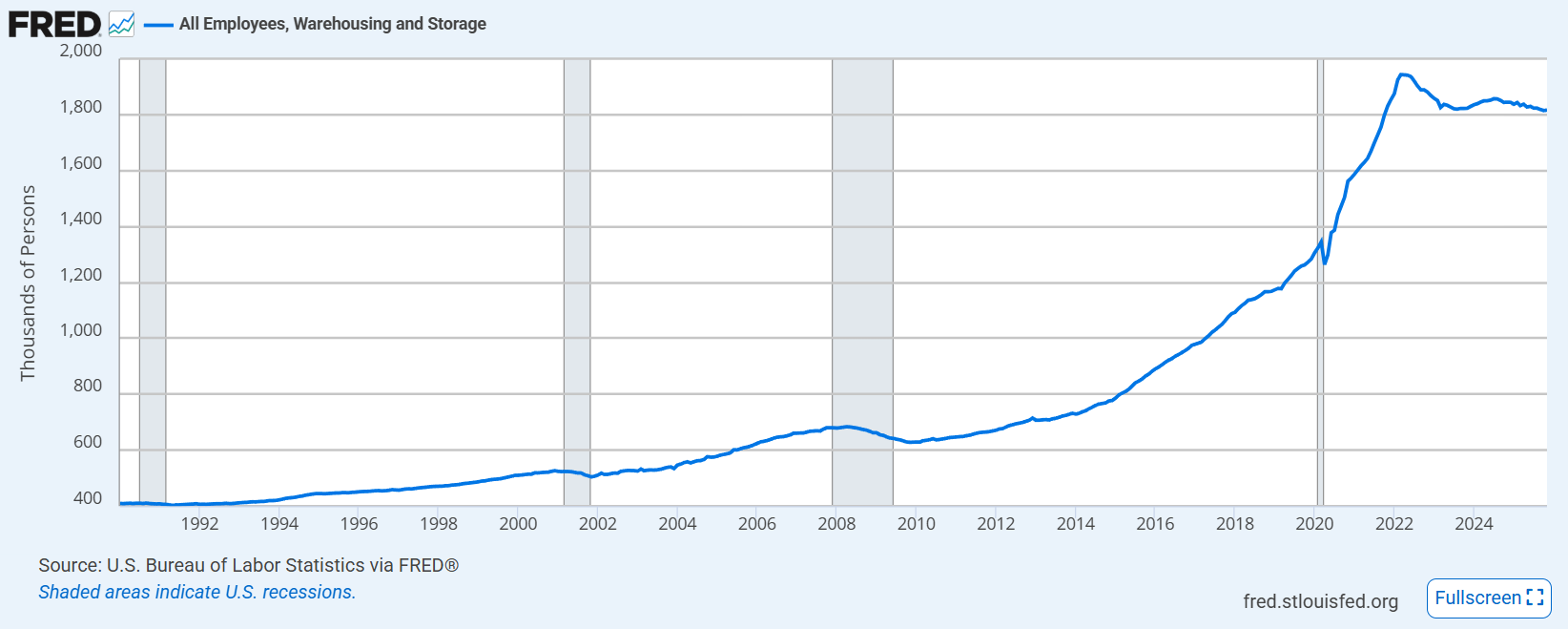
There has been a slight drop-off in employment in recent years, but it hasn’t been dramatic. The employment trend is visible in public data, making it easy to see how the sector has changed over time.
Warehouses Are Physical, and Communities Feel That
It’s easy to talk about logistics like it’s a cloud service. But it’s very physical with actual brick and mortar buildings, trucks, loading docks, and, sometimes, storage containers that show up in places people didn’t expect.
If you’re curious how local governments deal with the real-world side of storage and logistics, our recent reporting on Waverly’s efforts to regulate shipping containers on properties is a good example of how quickly a simple storage solution can turn into a community rules question.
Warehouse growth also intersects with downtown planning, jobs, and how local institutions partner on development. Our story on Guthrie and Sayre Borough exploring a downtown initiative is another reminder of how real projects can shape a town.